Preview of SAS Statistical Attractions At SAS Global Forum, March 22-25, Gaylord National Resort
by Maura Stokes
Heading to SAS Global Forum? Live in the DC area and still thinking about it? Can't attend this year but looking forward to the Proceedings going online after the conference? Well then, read on for a sneak preview.
Each year, we hold dry runs of the new statistical talks our developers are giving, both to critique them and to provide the presenters with a little 'real-life' practice. The audience consists of selected developers, testers, tech support staff, and education instructors, and we do our best to listen from the user perspective. Only after we've run through the gamut of potential 'user' questions do we move to feedback. This week, I sat in on the SAS statistical talks slated for this year's SGF.
Cows and Canada and PROC HPMIXED
First on the 'tour' was Tianlin Wang's talk titled All the Cows in Canada: Massive Mixed Modeling with the HPMIXED Procedure in SAS 9.2, which describes our new HPMIXED procedure. With large amounts of data, you may have effects with thousands of levels or complicated effects that include large interactions, and this may take PROC MIXED out of the running. Tianlin explained that PROC MIXED addresses the great majority of mixed models analyses, and that PROC HPMIXED is designed for the other situations. He provided a nice review of the sparse matrix methods he implemented that enable PROC HPMIXED to process selected, large mixed models. And yes, he included an analysis of Canadian cows, complete with pictures! We are a global company, after all.
This talk is scheduled for 8AM on Wednesday in Chesapeake 6.
 |
Fang Chen in action |
New Tool for Bayesian Modeling
Fang Chen gave his talk titled Bayesian Modeling Using the MCMC Procedure, which introduces our new general purpose simulation procedure that uses MCMC techniques to fit a wide range of Bayesian models. The flexibility of this tool requires more of the user, of course, than the BAYES statement that produces standard Bayesian analyses in the GENMOD, LIFEREG, and PHREG procedures. Fang described how you specify the prior distribution as well as build the likelihood function by using programming statements similar to those used in the NLMIXED procedure.
Fang discussed how to estimate functions of model parameters, construct power priors, and conduct sensitivity analyses. He illustrated the concepts with a simple binomial example. Fang has talked to many groups about Bayesian analysis using SAS in the past year, including ones at the Cinncinati ASA Chapter and the FDA. Be sure to track him down and tell him how you employ Bayesian techniques in your work.
This talk is scheduled for 11AM Tuesday in Chesapeake 6. Note that I am teaching a tutorial on Bayesian analysis on Sunday at SGF.
Customize Your ODS Statistical Graphics
The SAS internal call for papers this year requested us to focus on how to use our software, as well as showcasing new features, and Warren Kuhfeld answered the call. His talk is titled Modifying ODS Statistical Graphics Templates in SAS 9.2. While we designed the statistical graphics to be suitable for most applications, we know that there will be situations in which you need to modify your graphs. Warren's talk shows you how to make permanent modifications (you can use the point-and-click ODS Graphics Editor for ad hoc changes.)
Warren covered the basics on how to modify ODS graphics templates to control titles with dynamic variables, change axis labels, reference lines, markers, and colors, modify styles, and so on. Warren made it clear that you can accomplish a lot without becoming a template guru. The Tech Support folks thought the presentation covered the majority of the questions they'd addressed in the last year. No doubt, Warren's paper will be downloaded frequently in the coming years.
This talk is scheduled for 1:30PM on Tuesday in Maryland A
Group Sequential Analysis
Ironically, developer Yang Yuan, who works out of the Rockville office, had to drive to North Carolina to rehearse his presentation, titled Group Sequential Analysis Using the New SEQDESIGN and SEQTEST Procedures. He'll spend much less time commuting to SGF! Yang did a great job of introducing our software for the interim analysis of clinical trials data. Those statisticians attending from the pharmaceutical industry won't want to miss Yang's presentation.
This talk is scheduled for 1:30PM on Tuesday in Maryland 1.
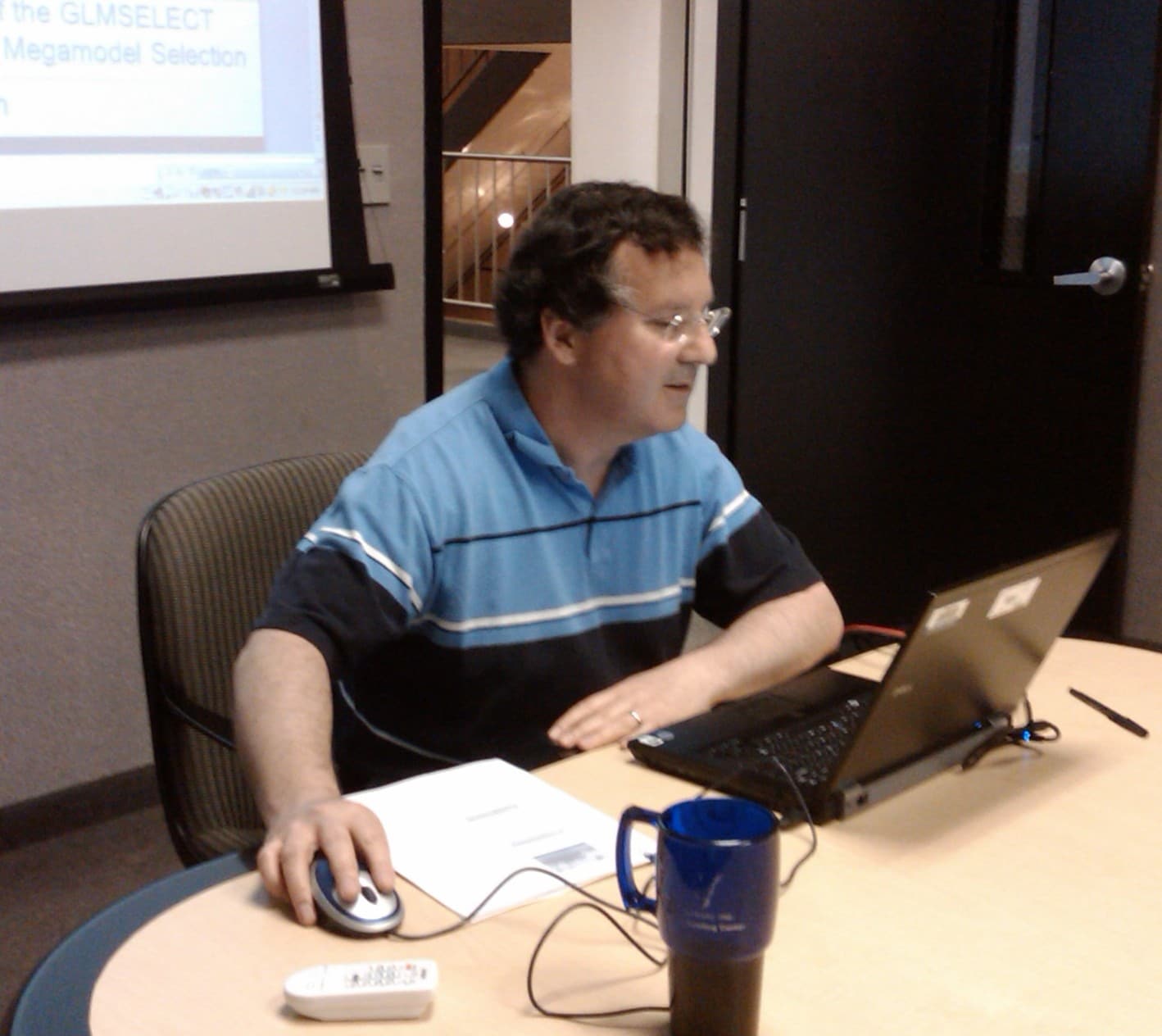 |
Robert Cohen prepares his talk |
Save the Last Dance for Me
Robert Cohen ends the conference this year with his 11 o'clock, Wednesday morning paper called Applications of the GLMSELECT Procedure for Megamodel Selection . No, this isn't a technical version of American Idol! Robert discussed several approaches to model selection, such as LASSO and stepwise regression, involving data with extremely large numbers of variables. Robert used some novel graphics to give us fresh insights about how these applications work. Robert is a very enthusiastic presenter, and he even invited us to participate with a pop quiz! Given the current controversy about whether automated variable selection methods are valid, this is a talk you can't miss. Do what you have to do to make it!
This talk is scheduled for 11AM on Wednesday in Chesapeake 6.
Much, Much More
While these five talks cover a lot of territory, you may want to start with Methods, Models, and More: New Analyses Available with SAS/STAT 9.2, presented by Bob Rodriguez (3:30PM National Harbor 3), which highlights some of the other exiting new work in SAS/STAT 9.2.
These talks are just a sampling of the many analytical presentations on the schedule at SAS Global Forum this year. Nearly three dozen SAS analytical presentations cover topics from data mining to forecasting to optimization. And don't forget the demo floor, where you can see Super Demo presentations on topics such as the coming interface to R in SAS/IML Studio and how to find value in your unstructured data.
And of course, the SAS talks are just a small piece of the conference. There are 20 user talks in the Statistics and Data Analysis section alone, and they look exceptional this year. I've been looking forward to some of these papers since I spotted the abstracts last fall.
Hope to see you at National Harbor!