 |
|
| The SHEWHART Procedure |
Constructing Charts for Means
The following notation is used in this section:
|
process mean (expected value of the population of measurements) |
|
process standard deviation (standard deviation of the population of measurements) |
|
mean of measurements in |
|
range of measurements in |
|
sample size of |
|
number of subgroups |
|
weighted average of subgroup means |
|
100 |
 th subgroup


 th percentile of the standard normal distribution
 Plotted Points
Each point on an  chart indicates the value of a subgroup mean (
 ). For example, if the tenth subgroup contains the values 12, 15, 19, 16, and 14, the value plotted for this subgroup is
 |
Central Line
By default, the central line on an chart indicates an estimate for  , which is computed as
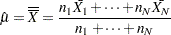 |
If you specify a known value ( ) for , the central line indicates the value of .
Control Limits
You can compute the limits in the following ways:
as a specified multiple (
 ) of the standard error of
  above and below the central line. The default limits are computed with
  (these are referred to as
  limits).
 as probability limits defined in terms of
 , a specified probability that exceeds the limits
The following table provides the formulas for the limits:
Control Limits |
|---|
LCL |
UCL |
 lower limit =

Probability Limits |
|---|
LCL |
UCL |
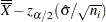
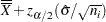
Note that the limits vary with  . If standard values and
  are available for and
  , respectively, replace
  with and
  with in Table 13.65.
You can specify parameters for the limits as follows:
Specify
with the SIGMAS= option or with the variable _SIGMAS_ in a LIMITS= data set. Specify
with the ALPHA= option or with the variable _ALPHA_ in a LIMITS= data set. Specify a constant nominal sample size
 for the control limits with the LIMITN= option or with the variable _LIMITN_ in a LIMITS= data set.
 Specify
with the MU0= option or with the variable _MEAN_ in a LIMITS= data set. Specify
with the SIGMA0= option or with the variable _STDDEV_ in a LIMITS= data set.
|
|
Copyright © SAS Institute, Inc. All Rights Reserved.