Object Privilege Inheritance
About Object Privilege Inheritance
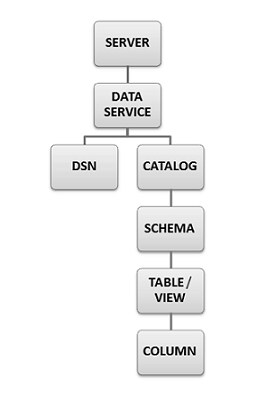
Where privileges on
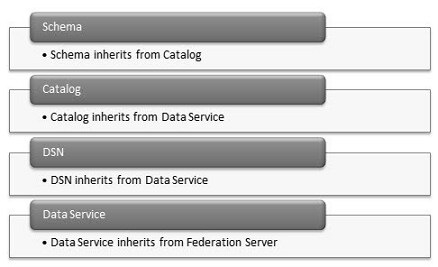
the server are inherited by the data service, privileges on the data
service are inherited by the DSN and catalog, and so on. This inheritance
hierarchy allows an administrator to set general security rules on
higher level objects, and then only set exceptions on the more specific
(subordinate) objects.
For example, there is
a group called SALES_GROUP whose members are allowed to select most
objects in the SALES_DATA data service. An administrator can assign
SELECT privilege on the SALES_DATA data service to the SALES_GROUP.
The SELECT privilege is inherited on all the catalogs of the SALES_DATA
data service, and all the schemas of those catalogs, and all the related
tables and views. There is a stipulation that the SALES_GROUP is not
allowed to see any data in a single catalog of the SALES_DATA data
service called EXECUTIVE_DATA. An administrator could then deny SELECT
privilege to the SALES_GROUP on that particular catalog. Members
of the SALES_GROUP would then not be able to select any data from
the EXECUTIVE_DATA catalog or any of its schemas. An administrator
can elect to grant all privileges on the EXECUTIVE_DATA catalog to
the EXECUTIVE_GROUP. An administrator can also deny SELECT privilege
to any member of the EXECUTIVE_GROUP on any subordinate object of
the EXECUTIVE_DATA catalog. In this way, general authorizations are
defined on higher level objects, and then exceptions are set on subordinate
objects. This minimizes the number of privileges that an administrator
must establish, and thereby reduces administration overhead. For
any object in the hierarchy of SAS Federation Server,
an administrator can request information about privileges held by
any user or group, including where in the hierarchy the privilege
was set and who the grantee of the privilege is, which can be a group
that the user is a member of, directly or indirectly.
Object Privilege Summary
User and Group Privileges
Privileges can be assigned
to a user or a group on any object. Group privileges are granted
and denied in the same manner as individual users. Users who are members
of a group inherit the privileges from the group unless explicitly
denied in the individual user account. Also, privileges set on a
group that is “closer” to a user take precedence over
privileges set on groups that are more distant.
For example, an administrator
grants SELECT privilege on table T1 to group G1, and that is the only
privilege on that table. If Bob is a direct member of group G1, then
Bob has privileges to select from T1. The administrator then denies
SELECT privilege on table T1 to group G10, where group G1 is a direct
member of group G10. User Bob continues to have privileges to select
from T1 because group G1 gives him the SELECT privilege. Group G1
is closer in relation to Bob than group G10—of which Bob is
also a member—but indirectly through membership in group G1.
If the administrator now denies SELECT privilege on table T1 to group
G2, where Bob is also a direct member of group G2, there is a conflict
in privileges. Group G1 indicates that Bob is granted SELECT privilege.,
However, group G2 indicates that Bob is denied SELECT privilege.
In these cases where there is a conflict, the user is denied the privilege.
In this example, Bob does not have SELECT privilege on table T1.
Maintaining Security Definitions for Tables, Views, or Columns
Overview
If an administrator
adds security definitions to a table, view, or column and then later
drops the table, view, or column, the security definitions are removed.
There might be times when a batch job drops the object and then re-creates
it. In this case, the administrator must reestablish security on the
object.
Tables
As a suggested best
practice, use the DELETE command to remove all of the rows from the
table, but leave the table definition intact so that the security
definitions remain with the table. Note that indexes created in the
data store remain on the table as well. This practice offers an advantage
if the table is merely being repopulated.
Granting Privileges
Overview
A system user has no
restrictions on SAS Federation Server and can grant
any privilege to any user. A SAS Federation Server
administrator can grant any privilege on the server to any user except
the ADMINISTER privilege itself. In other words, an administrator
cannot create other administrators. Only the system user can do this.
Grantor Precedence
Privilege Determination Summary
To summarize, privileges
can be determined by group membership and by object hierarchy. The
precise algorithm is described here:
-
For other users, a specific privilege is first checked at the current object in the hierarchy, in the following order:
-
On the current object, evidence of the privilege is first searched in the identification of the specific user. If a GRANT or DENY determination is made, the status is returned for the privilege, and privilege lookup stops.
-
User privilege search continues on the current object under the first level of group membership. If any group indicates DENY, the user is denied access. If all groups indicate GRANT, then the user is granted access. If a privilege determination cannot be made, the next level of group membership is checked.
-
On the current object, the privilege is searched for under the next level of group membership, per the same rules as the previous item. If no specific determination is made, repeat for all levels of group membership.
-
If no determination is made on the current object, then privilege determination goes to the next higher level in the object hierarchy. The privilege search algorithm repeats as described, first under the identification of the specific user, and then group membership.
-
If all objects in the hierarchy are searched and no privilege determination is made, then a DENY is returned for the privilege type for the use.
-
Privilege Caching
Overview
Privilege caching entails
capturing and reusing privileges enforced on a statement or request
submitted to SAS Federation Server. This improves
performance by reducing queries against internal system tables.
Privileges are cached
on demand. Each time privileges on a securable for a given grantee
are checked, the cache is examined initially to see whether the privilege
has already been cached. If so, enforcement cost is reduced by limiting
or eliminating queries against security-related system tables. Once
uncached privileges are retrieved from system table queries, they
are cached for subsequent use, stabilizing the cache based on actual
access patterns.
Copyright © SAS Institute Inc. All rights reserved.