Key SAS Clinical Standards Toolkit Components
Framework macros and
SAS macros specific to a standard, as described above, provide the
foundation for the SAS Clinical Standards Toolkit functionality. Three
other SAS Clinical Standards Toolkit components are also noteworthy:
The SAS Clinical Standards
Toolkit provides a set of driver modules (non-macro SAS code) that
illustrate all of the basic Toolkit functions using sample data provided
by SAS. These drivers can serve as templates for the Toolkit processes
you want to develop. These drivers might be submitted as batch or
interactive processes. They can be found in the programs subfolder
for each standard (for the relative
location of this folder, see Folder Hierarchy for CDISC ADaM 2.1 Sample). For a more complete
description of what these drivers do, see Using the SAS Clinical Standards Toolkit.
The SAS Clinical Standards
Toolkit also provides a series of framework properties files and properties
files specific to a standard (such as initialization, validation,
and report properties files). You can use these files to both define
global macro variables and to set their default values. These typically
can be found in the same folders as the driver modules. Use of these
property files is optional but recommended, and you can add your own
global macro variables as needed.
Perhaps the single
most important file used by the SAS Clinical Standards Toolkit is
the SASReferences data set. The SASReferences data set captures all
the input and output file library and file references associated with
any given process. Here is a sample:
Sample SASReferences Data Set (CDISC SDTM 3.1.2 Validation
Process)
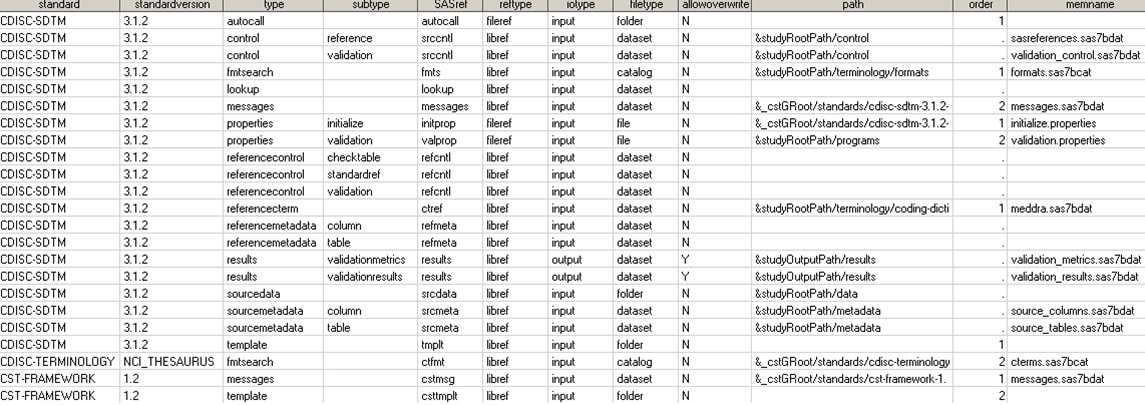
A complete discussion
of the SASReferences data set is provided in Chapter 5, “SASReferences File,” in the SAS
Clinical Standards Toolkit: User's Guide.
The SAS Clinical Standards Toolkit defines a standard SASReferences
data set for each supported standard (found in the
global standards library directory/standards/standard/control directory).
Copyright © SAS Institute Inc. All rights reserved.