Problem Note 69079: The Table Loader code generator ignores any Oracle hints in a SELECT statement for an input table that uses an SQL query
 |  |  |  |
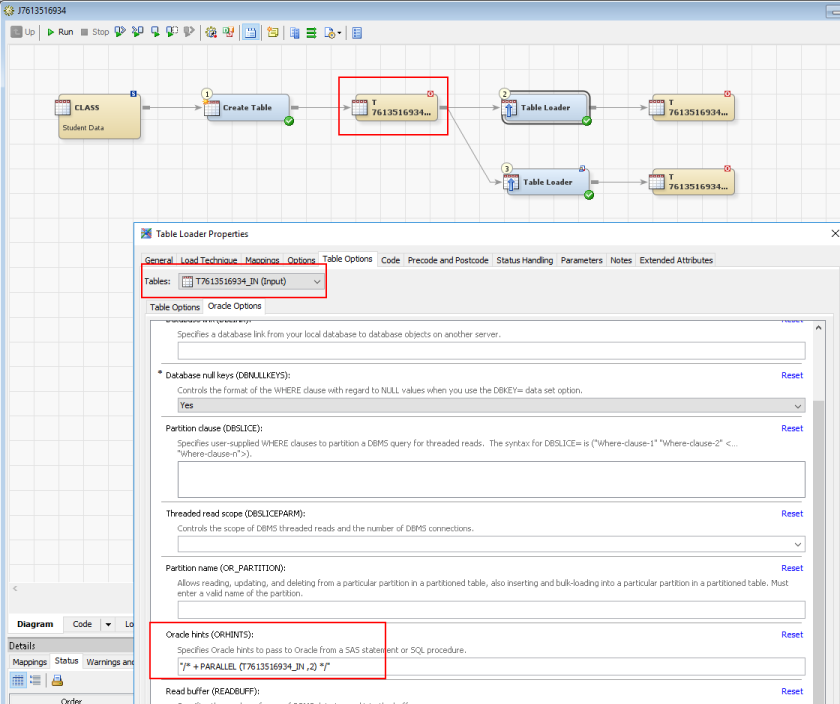
SAS® Data Integration Studio 4.905 does not observe any Oracle hints (or ORHINTS) for an input table that uses the Table Loader transformation with an SQL query:
However, the code generator does observe the ORHINTS option for the output table:
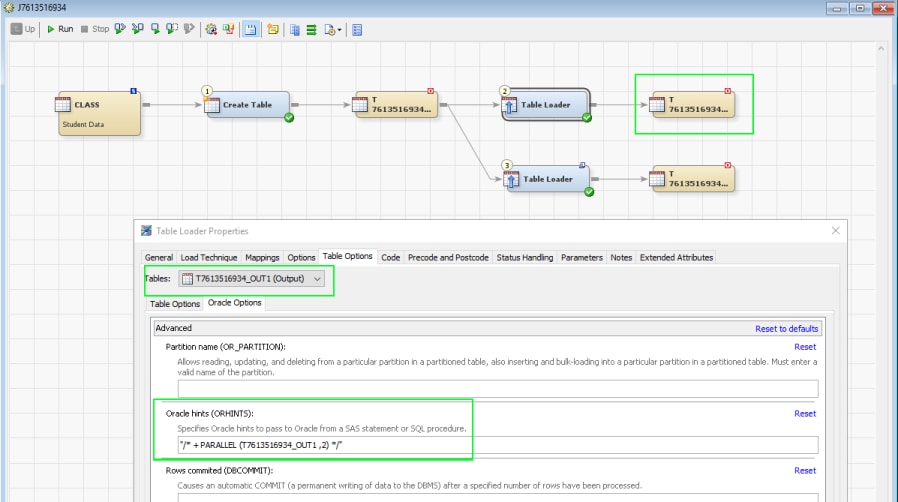
The relevant code in the log file looks like the following:
/* insert new records into the controller table */
insert into oralib.T7613516934_OUT1
(ORHINTS = "/* + PARALLEL (T7613516934_OUT1 ,2) */",
Name, Sex, Age, Height, Weight)
select
Name, Sex, Age, Height, Weight
from &etls_lastTable
;
quit;
However, the code should look like the following:
/* insert new records into the controller table */
insert into oralib.T7613516934_OUT1
(ORHINTS = "/* + PARALLEL (T7613516934_OUT2 ,2) */",
Name, Sex, Age, Height, Weight)
select
Name, Sex, Age, Height, Weight
from &etls_lastTable (&etls_tableOptions)
;
quit;
In the automatically created code, the ORHINTS option is properly assigned to the macro variable %etls_tableOptions. However, the option is not used in the INSERT statement:
%let etls_tableOptions = %nrquote(ORHINTS = "/* + PARALLEL (T7613516934_IN ,2) */");
The only workaround is to select User written body for the Code generation mode setting of the Table Loader properties for the transformation:

Then append (&etls_tableOptions) to from &etls_lastTable within the INSERT statement.
Operating System and Release Information
| Product Family | Product | System | Product Release | SAS Release | ||
| Reported | Fixed* | Reported | Fixed* | |||
| SAS System | SAS Data Integration Studio | Microsoft® Windows® for x64 | 4.905 | 9.4 TS1M7 | ||
| Microsoft Windows 8 Enterprise 32-bit | 4.905 | 9.4 TS1M7 | ||||
| Microsoft Windows 8 Enterprise x64 | 4.905 | 9.4 TS1M7 | ||||
| Microsoft Windows 8 Pro 32-bit | 4.905 | 9.4 TS1M7 | ||||
| Microsoft Windows 8 Pro x64 | 4.905 | 9.4 TS1M7 | ||||
| Microsoft Windows 8.1 Enterprise 32-bit | 4.905 | 9.4 TS1M7 | ||||
| Microsoft Windows 8.1 Enterprise x64 | 4.905 | 9.4 TS1M7 | ||||
| Microsoft Windows 8.1 Pro 32-bit | 4.905 | 9.4 TS1M7 | ||||
| Microsoft Windows 8.1 Pro x64 | 4.905 | 9.4 TS1M7 | ||||
| Microsoft Windows 10 | 4.905 | 9.4 TS1M7 | ||||
| Microsoft Windows 11 | 4.905 | 9.4 TS1M7 | ||||
| Microsoft Windows Server 2008 | 4.905 | 9.4 TS1M7 | ||||
| Microsoft Windows Server 2008 R2 | 4.905 | 9.4 TS1M7 | ||||
| Microsoft Windows Server 2008 for x64 | 4.905 | 9.4 TS1M7 | ||||
| Microsoft Windows Server 2012 Datacenter | 4.905 | 9.4 TS1M7 | ||||
| Microsoft Windows Server 2012 R2 Datacenter | 4.905 | 9.4 TS1M7 | ||||
| Microsoft Windows Server 2012 R2 Std | 4.905 | 9.4 TS1M7 | ||||
| Microsoft Windows Server 2012 Std | 4.905 | 9.4 TS1M7 | ||||
| Microsoft Windows Server 2016 | 4.905 | 9.4 TS1M7 | ||||
| Microsoft Windows Server 2019 | 4.905 | 9.4 TS1M7 | ||||
| Microsoft Windows Server 2022 | 4.905 | 9.4 TS1M7 | ||||
| Windows 7 Enterprise 32 bit | 4.905 | 9.4 TS1M7 | ||||
| Windows 7 Enterprise x64 | 4.905 | 9.4 TS1M7 | ||||
| Windows 7 Home Premium 32 bit | 4.905 | 9.4 TS1M7 | ||||
| Windows 7 Home Premium x64 | 4.905 | 9.4 TS1M7 | ||||
| Windows 7 Professional 32 bit | 4.905 | 9.4 TS1M7 | ||||
| Windows 7 Professional x64 | 4.905 | 9.4 TS1M7 | ||||
| Windows 7 Ultimate 32 bit | 4.905 | 9.4 TS1M7 | ||||
| Windows 7 Ultimate x64 | 4.905 | 9.4 TS1M7 | ||||
| Type: | Problem Note |
| Priority: | high |
| Date Modified: | 2022-04-12 09:53:45 |
| Date Created: | 2022-04-12 06:19:09 |