sql-expression
Produces a value from a sequence of operands and operators.
Syntax
operand operator operand
Required Arguments
operand
is one of the following:
-
a column-name, which is described in column-name.
-
a CASE expression, which is described in CASE Expression.
-
any supported SAS function. PROC SQL supports many of the functions available to the SAS DATA step. Some of the functions that are not supported are the variable information functions, functions that work with arrays of data, and functions that operate on rows other than the current row. Other SQL databases support their own sets of functions. Functions are described in the SAS Functions and CALL Routines: Reference.
-
a summary-function, which is described in summary-function.
-
a query expression, which is described in query-expression.
operator
is described in Operators and the Order of Evaluation.
Details
SAS Functions
PROC
SQL supports many of the functions available to the SAS DATA step.
Some of the functions that are not supported are the variable information
functions and functions that work with arrays of data. Other SQL databases
support their own sets of functions. For example, the SCAN function
is used in the following query:
    select style, scan(street,1) format=$15.
       from houses;
PROC SQL also supports
any user-written functions, except those functions with array elements,
that are created using Chapter 19, “FCMP Procedure” in Base SAS Procedures Guide.
See the SAS Functions and CALL Routines: Reference for complete documentation of SAS functions. Summary
functions are also SAS functions.
For more information,
see summary-function.
USER Literal
USER can be specified in a view definition.
For example, you can create a view that restricts access to the views
in the user's department. Note that the USER literal value is stored
in uppercase, so it is advisable to use the UPCASE function when comparing
to this value:
   create view myemp as
      select * from dept12.employees
where upcase(manager)=user;Operators and the Order of Evaluation
The order in which operations are evaluated is the same
as in the DATA step with this one exception: NOT is grouped with the
logical operators AND and OR in PROC SQL; in the DATA step, NOT is
grouped with the unary plus and minus signs.
Unlike missing values
in some versions of SQL, missing values in SAS always appear first
in the collating sequence. Therefore, in Boolean and comparison operations,
the following expressions resolve to true in a predicate:
   3>null
  -3>null
   0>null
You can use parentheses
to group values or to nest mathematical expressions. Parentheses
make expressions easier to read and can also be used to change the
order of evaluation of the operators. Evaluating expressions with
parentheses begins at the deepest level of parentheses and moves outward.
For example, SAS evaluates A+B*C as A+(B*C), although you can add
parentheses to make it evaluate as (A+B)*C for a different result.
Higher priority operations
are performed first: that is, group 0 operators are evaluated before
group 5 operators. The following table shows the operators and their
order of evaluation, including their priority groups.
|
See BETWEEN Condition.
|
||
|
see CONTAINS Condition.
|
||
|
See EXISTS Condition.
|
||
|
See IN Condition.
|
||
|
See IS Condition.
|
||
|
See LIKE Condition.
|
||
|
sounds like (use with
character operands only). See Retrieving Values with the SOUNDS-LIKE Operator.
|
||
|
equal to truncated strings
(use with character operands only). See Truncated String Comparison Operators.
|
||
Truncated String Comparison Operators
PROC SQL supports
truncated string comparison operators. (See Group 7 in Operators and Order of Evaluation.) In a truncated
string comparison, the comparison is performed after making the strings
the same length by truncating the longer string to be the same length
as the shorter string. For example, the expression
'TWOSTORY'
                        eqt 'TWO'
is true because the string 'TWOSTORY' is reduced
to 'TWO' before the comparison is performed. Note that the truncation
is performed internally; neither operand is permanently changed.
Query Expressions (Subqueries)
A query expression is called a subquery when it is used
in a WHERE or HAVING clause. A subquery is a query expression that
is nested as part of another query expression. A subquery selects
one or more rows from a table based on values in another table.
Depending on the clause
that contains it, a subquery can return a single value or multiple
values. If more than one subquery is used in a query expression,
then the innermost query is evaluated first, then the next innermost
query, and so on, moving outward.
PROC SQL allows a subquery
(contained in parentheses) at any point in an expression where a simple
column value or constant can be used. In this case, a subquery must
return a single value, that is, one row with only one column.
The following is an
example of a subquery that returns one value. This PROC SQL step subsets
the PROCLIB.PAYROLL table based on information in the PROCLIB.STAFF
table. (PROCLIB.PAYROLL is shown in Creating a Table from a Query's Result, and PROCLIB.STAFF is shown
in Joining Two Tables.)
PROCLIB.PAYROLL contains employee identification numbers (IdNumber)
and their salaries (Salary) but does not contain their names. If you
want to return only the row from PROCLIB.PAYROLL for one employee,
then you can use a subquery that queries the PROCLIB.STAFF table,
which contains the employees' identification numbers and their names
(Lname and Fname).
proc sql;
    title 'Information for Earl Bowden';
    select *
       from proclib.payroll
       where idnumber=
             (select idnum
             from proclib.staff
             where upcase(lname)='BOWDEN');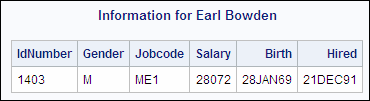
Subqueries can return
multiple values. The following example uses the tables PROCLIB.DELAY
and PROCLIB.MARCH. These tables contain information about the same
flights and have the Flight column in common. The following subquery
returns all the values for Flight in PROCLIB.DELAY for international
flights. The values from the subquery complete the WHERE clause in
the outer query. Thus, when the outer query is executed, only the
international flights from PROCLIB.MARCH are in the output.
proc sql outobs=5;
   title 'International Flights from';
   title2 'PROCLIB.MARCH';
   select Flight, Date, Dest, Boarded
      from proclib.march
      where flight in
            (select flight
             from proclib.delay
             where destype='International');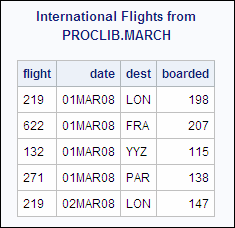
Sometimes it is helpful
to compare a value with a set of values returned by a subquery. The
keywords ANY or ALL can be specified before a subquery when the subquery
is the right-hand operand of a comparison. If ALL is specified, then
the comparison is true only if it is true for all values that are
returned by the subquery. If a subquery returns no rows, then the
result of an ALL comparison is true for each row of the outer query.
If ANY is specified,
then the comparison is true if it is true for any one of the values
that are returned by the subquery. If a subquery returns no rows,
then the result of an ANY comparison is false for each row of the
outer query.
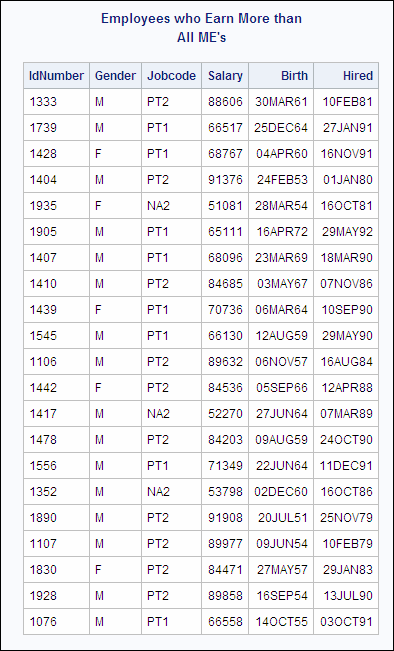
The following example
selects all of the employees in PROCLIB.PAYROLL who earn more than
the highest paid
ME3:
Correlated Subqueries
In a correlated
subquery, the WHERE expression in a subquery refers to values in a
table in the outer query. The correlated subquery is evaluated for
each row in the outer query. With correlated subqueries, PROC SQL
executes the subquery and the outer query together.
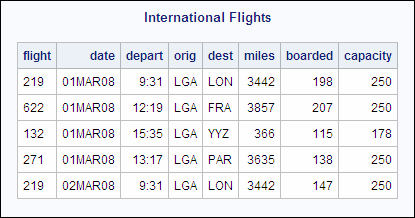
The following example
uses the PROCLIB.DELAY and PROCLIB.MARCH tables. A DATA step ( PROCLIB.DELAY) creates PROCLIB.DELAY. PROCLIB.MARCH is shown in Producing All the Possible Combinations of the Values in a Column. PROCLIB.DELAY has the Flight, Date, Orig, and Dest columns
in common with PROCLIB.MARCH:
proc sql outobs=5;
   title 'International Flights';
   select *
      from proclib.march
      where 'International' in
           (select destype
            from proclib.delay
            where march.Flight=delay.Flight);
The subquery resolves
by substituting every value for MARCH.Flight into the subquery's WHERE
clause, one row at a time. For example, when MARCH.Flight=
219,
the subquery resolves as follows:
Subqueries and Efficiency
-
Use the MAX function in a subquery instead of the ALL keyword before the subquery. For example, the following queries produce the same result, but the second query is more efficient:
proc sql; select * from proclib.payroll where salary> all(select salary from proclib.payroll where jobcode='ME3'); proc sql; select * from proclib.payroll where salary> (select max(salary) from proclib.payroll where jobcode='ME3'); -
With subqueries, use IN instead of EXISTS when possible. For example, the following queries produce the same result, but the second query is usually more efficient:
proc sql;
   select *
      from proclib.payroll p
      where exists (select *
                    from staff s
                    where p.idnum=s.idnum
                       and state='CT');

proc sql;
   select *
      from proclib.payroll
      where idnum in (select idnum
                         from staff
                         where state='CT');
Copyright © SAS Institute Inc. All rights reserved.