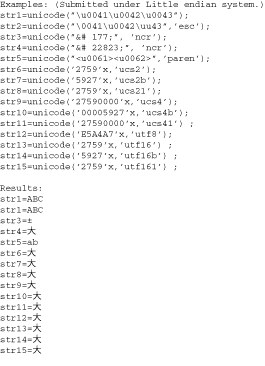
UNICODE Function
converts Unicode characters to the current SAS session
encoding.
| Category: | Character |
Syntax
STR=UNICODE(<instr> (,<Unicode
type> ))
Required Arguments
- Unicode type
-
Unicode character formats
ESC Unicode Escape (for example, \u0042 ). ESC is the default format. NCR Numeric Character Representation (for example, 大 or ± ; ) PAREN Unicode Parenthesis Escape (for example, <u0061>) UCS2 UCS2 encoding with native endian. UCS2B UCS2 encoding with big endian. UCS2L UCS2 encoding with little endian. UCS4 UCS4 encoding with native endian. UCS4B UCS4 encoding with big endian. UCS4L UCS4 encoding with little endian. UTF16 UTF16 encoding with big endian. UTF16B UTF16 encoding with big endian. UTF16L UTF16 encoding with little endian. UTF8 UTF8 encoding.