Steps
-
-
In the SAS Program Editor,
select
File Open Program
, and then select
CST_SDTM/programs/create_formatsfromcrtdds.sas.
-
Select
RunSubmit.
The code outputs to
the SAS log and creates a codelist_results data set in the
CST_SDTM/results directory
and creates a catalog named cterms in the
CST_SDTM/derived/formats directory.
Note: For this program,
the library information was cleaned up, so these files are not immediately
accessible under
Libraries in the SAS Explorer.
On Microsoft Windows, you can access these files through the SAS Explorer
by navigating from within the SAS Explorer starting at the node labeled
My
Computer. On UNIX, it is necessary for you to copy these
data sets into a directory that is viewable by the SAS Explorer (for
example, your
Home Directory listed under
Favorite
Folders).
At the end of the run,
the FMTLIB output appears.
-
Review the log to see
whether there are any errors or warnings.
There should be no errors
or warnings.
-
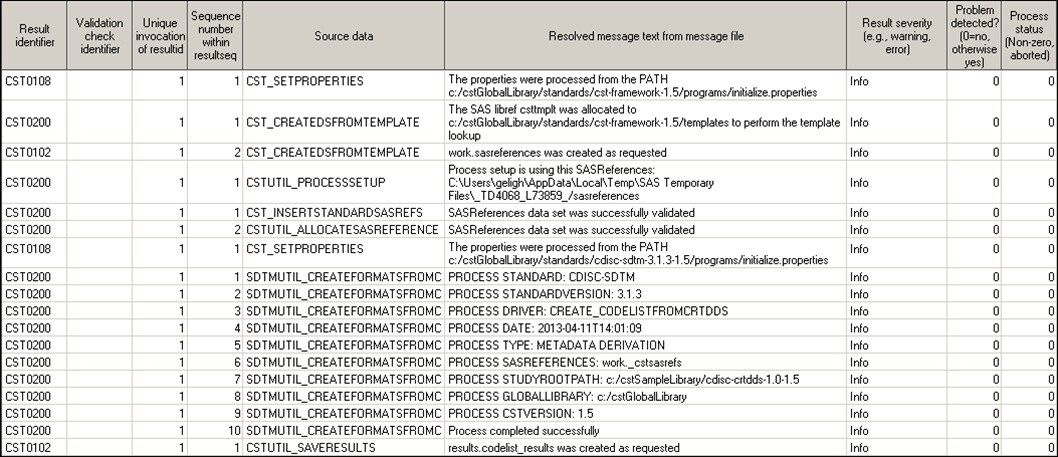
Review the codelist_results
data set in the
CST_SDTM/results directory
to ensure that the following conditions are met:
-
The
Resolved message
text from message file column (named message) contains
correct paths and process metadata.
-
The column labeled
Process
status (named _cst_rc) is
0 for
all records. There are not any checks with the result
severity='Warning:
                                             Check not run'
.
-
The data set contains 18 records.
One of the last records must report
Process completed
                                             successfully
.
See the sample output
above.
Note: Values that refer to temporary
directories, files, or
PROCESS DATE: vary.
-
Ensure that the
CST_SDTM/derived/formats directory
contains a cterms catalog (named cterms.sas7bcat).
-
Open the cterms catalog
and verify that it has 53 formats.
Note: The data set can show a different
number of formats if it previously existed. In this case, the 53 formats
are appended to the file.
-
Copyright © SAS Institute Inc. All rights reserved.