How SCL Programs Execute for FRAME Entries
Introduction
SCL programs for FRAME entries use code sections that are named with reserved labels
to process the phases of program initialization (INIT), main processing (MAIN), and
termination (TERM).
Processing the INIT Section
Statements
in the INIT section typically perform actions such as
-
initializing variables
-
importing values through macro variables
-
displaying initial messages on the window's message line
-
opening SAS tables and external files that are used by the entry
-
processing parameter values that are passed to the FRAME entry
By default, INIT executes
only once, before the entry's window opens, for each invocation of
a FRAME.
Processing Labeled Sections for Components
Introduction
Sections of frame SCL programs that are named with object labels execute when an action is performed on the component, such as selecting the component or changing its value. The CONTROL LABEL statement
in SCL controls the execution of labeled sections. CONTROL LABEL is on by default
for FRAME entries, making it easier to create labeled statement sections to execute
when you perform an action on a component. For details on the CONTROL LABEL statement,
see the SAS Component Language:
Reference and the _setControl method of the Frame class in the SAS/AF online Help.
Order of Processing for Multiple Window Components
When a frame needs to process more than one component, a predefined order (known
as the window order) controls the processing order. The
window order starts from the top row of the window and moves to the bottom row. Additionally,
window order moves from left to right in each row.
However, if one component (such as a container box) contains other components, then
all the contained components
are processed as a group before other components on the right are processed.
Some hosts and display
devices also honor the window order when you use the TAB key to move
the cursor between fields. See “Setting the Tab Order”
in the SAS/AF online Help
for more information.
Note: There is an exception to
the window order. When the _preTerm, _postInit, and _refresh methods
are run, all extended tables in the frame are processed before any
other components.
Example: Order of Processing for Multiple Window Components
Consider the following
FRAME entry:
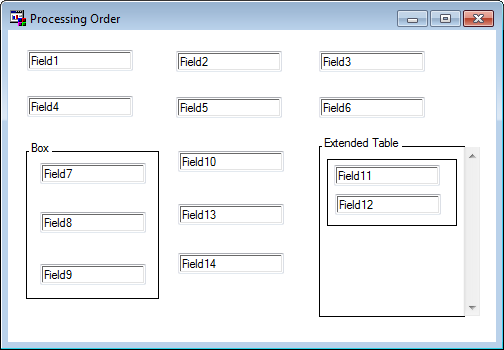
The order of processing
for this window is FIELD1, FIELD2, FIELD3, FIELD4, FIELD5, FIELD6,
BOX, FIELD7, FIELD8, FIELD9, FIELD10, TABLE, FIELD11, FIELD12, FIELD13,
and FIELD14.
Note carefully the order
of processing components in the container box labeled Box and the extended table labeled Table, as well as the fields within them. For example, FIELD10 is not
processed until after FIELD7, FIELD8, and FIELD9 are processed because
they are contained in Box, which appears
before FIELD10. Also, FIELD11 and FIELD12 are processed before FIELD13
because they are contained in Table, which
starts in the row above FIELD13.
Processing the MAIN Section
Introduction
Statements in the MAIN section typically perform actions
such as:
-
validating field values
-
calculating values for computed variables that are based on user input
-
displaying selection lists that are developed through SCL functions
-
submitting Base SAS software code
-
invoking secondary windows
-
querying and executing commands that are issued by users
-
retrieving values from SAS tables or from external files
By default, MAIN executes
each time the follows occurs:
-
a user presses ENTER or RETURN (or any function key) after modifying one or more fields or text entry controls, provided that the modified fields contain valid values. After you modify fields and press ENTER, all modified fields are checked to verify that their values satisfy their attribute specifications. (However, the
requiredattribute is not checked until you attempt to end from the entry.) -
you activate a control by modifying or selecting it.
Each of these actions first runs the labeled section that is associated with the object
and then runs MAIN. The new values of the window variables are then displayed in
the corresponding fields.
To override the default behavior of when MAIN executes, use the CONTROL statement in SCL. (For
details, see the SAS Component Language: Reference.)
Forcing MAIN to Execute
Although the default behavior is for MAIN to execute only when all field or
component values are valid, you can force MAIN to execute even when some fields or
components
contain invalid values or when an application-specific command is issued. SCL provides
CONTROL ENTER, CONTROL ERROR, CONTROL ALLCMDS, and CONTROL ALWAYS statements
that cause the MAIN section to execute whenever you press ENTER or RETURN, even if
no fields are modified or if modified fields do not contain valid values. If the FRAME
entry contains no selectable or modifiable objects, then MAIN cannot execute unless
a CONTROL ENTER or CONTROL ALWAYS statement is in effect.
To enable MAIN to execute even if a field is in error, you must specify CONTROL ERROR
or CONTROL ALWAYS. The _setControl method of the Frame class also modifies how the
FRAME entry processes errors and input events.
See the SAS
Component Language: Reference for information about CONTROL
statement options.
Handling Invalid Values in MAIN
If a modification to a text entry control introduces an attribute error, the
labeled section for that control does not execute. However, the labeled
sections for other controls that are also modified will execute.
If an attribute error is detected, MAIN does not execute. Instead, fields or controls
that contain
invalid values are highlighted and an error message is displayed. The error attributes
that you specified determine what is flagged as an error. You can enable users to
correct an attribute error in the window. If the program contains CONTROL ERROR and
CONTROL LABEL, or if the _setControl method has put these statements into effect,
you can include statements in the labeled section
that make a correction, as shown in the following example:
INIT:
    control error;
return;

TEXTENTRY1:
    if error(textentry1) then do;
          textentry1.text=.;
          erroroff textentry1;
          _msg_='Value was invalid. It has been reset.';
    end;
return;
Processing the TERM Section
Introduction
Statements
in the TERM section typically perform actions such as
-
updating and closing SAS tables and external files that were opened by the entry
-
exporting values of SCL variables to macro variables for later use
-
branching to another entry in the application by using the DISPLAY routine
-
submitting Base SAS software code for execution
-
deleting SCL lists or SCL objects that are created in the FRAME entry
TERM executes when you
issue either an END command or a CANCEL command.
Processing an END Command
If you issue the END command,
-
The SCL system variable _STATUS_ is set to
E. -
Modified fields are checked for valid values.
-
Statements in the MAIN section execute if fields are modified and their values are valid.
-
Required fields are checked to verify that they are not blank.
-
Any SCL statements in the TERM section execute.
-
The _term method runs for the frame and for all components.
-
The window closes and control returns to the parent or calling entry.
Note: If any fields contain invalid
values when MAIN executes, MAIN processing highlights the errors and
returns control to the application. In that case, TERM does not execute.
If any empty fields
have the
required attribute, TERM does not execute. Instead, the empty required fields are highlighted
and an
error message is displayed. You must provide values for all required fields and issue
the END command again before the TERM section will execute.
After all these conditions are satisfied, the SCL statements in TERM execute. After
the TERM section executes, the window closes and
the entry terminates. Control returns to the SAS process that invoked the entry.
Processing a CANCEL Command
If you issue the CANCEL command,
-
The SCL system variable _STATUS_ is set to
C. -
No field validation is performed.
-
Sny SCL statements in the TERM section execute.
-
The _term method runs for the frame and for all components.
-
The window closes and control returns to the parent or calling entry.
Processing an ENDSAS, BYE, or System Closure Command
If you issue the ENDSAS or BYE command, or if you use the system
closure menu when
the FRAME entry is running without the SAS Application Work Space (AWS), then:
-
The SCL system variable _STATUS_ is set to
' '(blank). -
Statements in the TERM section do not run.
-
The _term method runs for the frame and for all components.
-
The window closes.
Note: The SAS AWS is the container
window for SAS software.
Automatic Termination of SCL Objects When an Application Ends
Introduction
When an application ends, the software scans for any remaining SCL objects that have
not yet been deleted and sends a _term method to them. In most cases, this is completely
benign. In a few cases, it might indicate
a defect in your application; that is, perhaps you did not delete something that you
should have, or perhaps your _term method omitted a
SUPER(_self_, '_term_');.
Sometimes an application cannot delete an object because it does not know whether
the object is still in use; the AUTOTERM feature
deletes such objects by running the _term method.
Using the AUTOTERM= Option to Control the AUTOTERM Feature
If the AUTOTERM feature causes problems
in your application, you can disable it by adding the AUTOTERM= option
to your AF, AFA, or AFSYS command:
AF C=lib.cat.member.name AUTOTERM=term-value
AFA C=lib.cat.member.name AUTOTERM=term-value
AFSYS AUTOTERM term-value
(You can use the AFSYS
command once an application is running.) Values for term-value are
ON
enables the AUTOTERM
feature. AUTOTERM is on by default. Use this value to enable the feature
if it is turned off.
OFF
disables the AUTOTERM feature, which means that the software does not invoke the _term
method on objects when a task is terminated. This value makes the AUTOTERM feature
compatible
with earlier releases of SAS/AF software.
VERBOSE
prints a note and dumps the object list of each object that still exists when a task
is terminated. This value works
even if AUTOTERM is OFF; it serves as a debugging aid to identify which objects still
exist but whose _term method has not run.
NOVERBOSE
disables the VERBOSE
option. NOVERBOSE is the default.
You cannot combine options
in one string; use separate AUTOTERM= options on the command line,
or use separate AFSYS commands.
Using the VERBOSE Value to Help Debug Your Application
Use the VERBOSE value when you invoke your application or while the application
is running. With VERBOSE, the software displays a note about any object that still
exists at task termination, and it dumps the object list to the log before
sending the _term method. Without VERBOSE, _term is invoked and no note is displayed
in the log. Using VERBOSE
as you develop your applications is helpful because it can highlight objects that
your application fails to delete.
In a few rare cases, you might begin to see program halts as your application completes.
These halts are often caused when one object is deleted and another object that references
it does not know that it has been deleted.
For example, consider a class named Manager that maintains a list of instances of
Message File objects. The Manager
class has a _term method that unconditionally sends _term to each item in its list
of Message File objects:
term: private method;
   dcl num i;
   do i=1 to listlen(msgObjs);
      dcl object msgObj;
      msgObj=getitemn(msgObjs,i);
      msgObj._term();
   end;
   _self_._super();
 endmethod;
However, when a task ends, AUTOTERM may send _term to a Message File object before running the Manager's _term, so the Manager's
list becomes stale (that is, it contains object identifiers of deleted
Message File objects). The proper fix in this and similar situations
is to verify other dependent objects in the _term before sending methods
to them. (In this case, the Message File object is not aware of the
Manager and therefore cannot ask the Manager to remove the object
identifier from the Manager's list of Message File objects.)
To determine whether
a number is a valid list identifier, use
LISTLEN(number) > -1
Then, to determine whether a list identifier is an object identifier, use
HASATTR(listid, 'O')
(The 'O' is a letter O as in Object.) For example, the Manager's _term method is more
correctly implemented as follows:
term: private method;
   dcl num i;
   do i=1 to listlen(msgObjs);
      dcl object msgObj;
      msgObj=getitemn(msgObjs,i);
      if listlen(msgObj) > -1 and hasattr(msgObj,'O') then
         msgObj._term();
   end;
   _self_._super();
 endmethod;
Note: As an alternative to the
above solution, when _term is
run on a Message File object, the Message File object could send an
event. The manager would then have a handler for the event and could
remove the object from its list.
Copyright © SAS Institute Inc. All Rights Reserved.
Last updated: May 27, 2017